Bangkok's Happy Hours: How to Drink Well for Half the Price
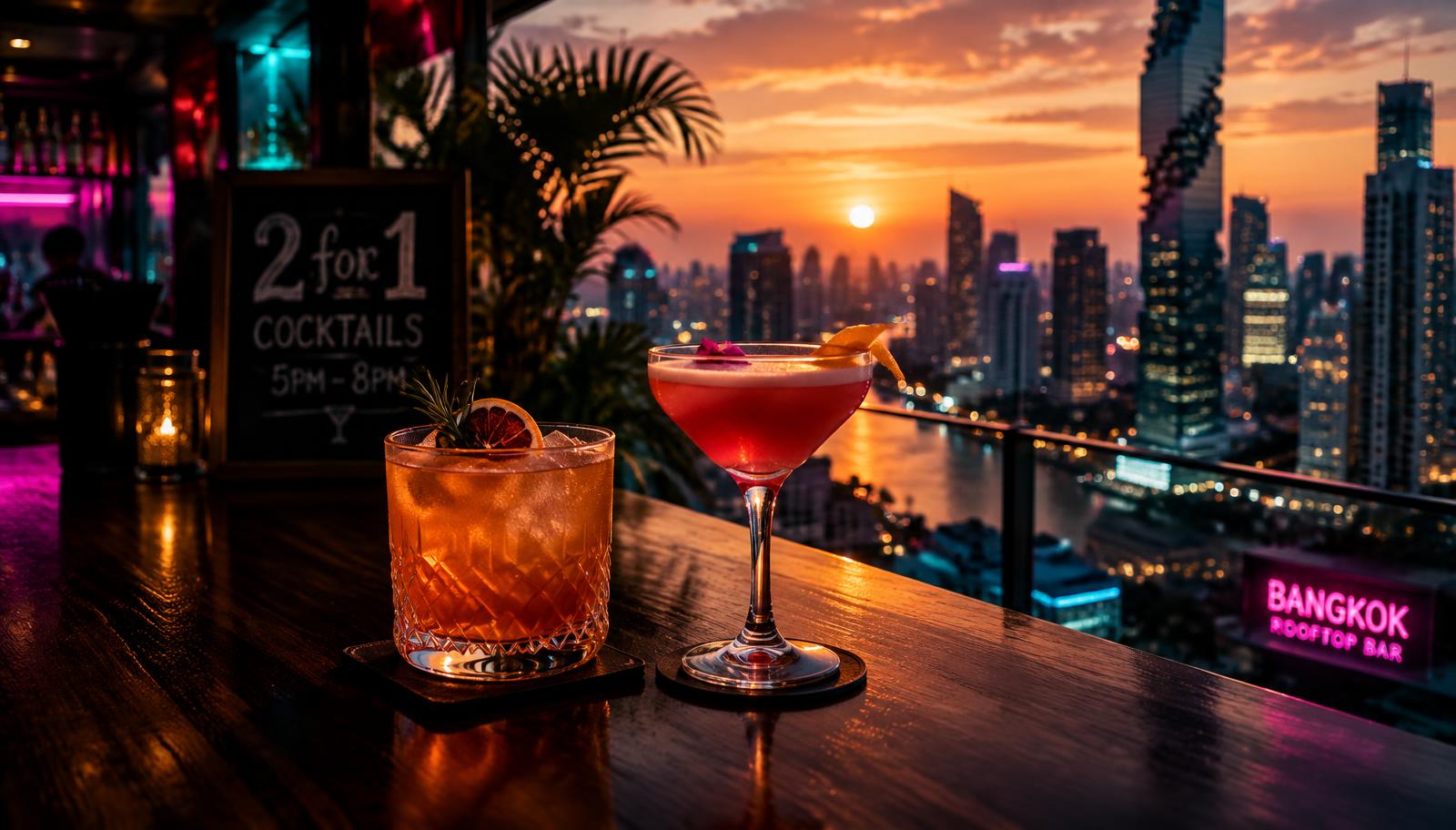
Here is a fact about Bangkok that first-time visitors refuse to believe until they see the receipt: you can drink a fourteen-dollar craft cocktail at the top of one of the tallest buildings in Southeast Asia for seven dollars, if you show up at the right hour. The city that runs on nightlife has quietly built one of the most developed happy hour economies on earth. Almost every serious bar in town has one. Many have two. And the discount is rarely a watered-down consolation prize — it is often the exact same drink, the exact same view, for half the money.
Understanding how this works is the difference between a Bangkok trip that torches your budget by Wednesday and one where you drink in the city's best rooms every single night and fly home with money left over. This is a guide to that economy: why it exists, how the deals are structured, and where each kind of deal lives.
Why Bangkok discounts the best hours of the day
Start with the basic math of the Bangkok bar. Rent is high in the areas people want to drink in — along Sukhumvit, around the river, up in the towers — but labor and ingredients cost far less than in London, New York or Sydney. A bar's drinks carry a healthy margin even at half price. What a bar cannot buy is a full room. An empty rooftop at 6 p.m. is dead inventory: the view is the same, the bartender is already on the clock, and every seat that sits empty from five to eight is revenue that never comes back.
So the city's bars compete ferociously for the early evening. Two-for-one cocktails between five and eight are the standard offer — not a promotion run occasionally, but a structural feature of the market, advertised on sandwich boards, chalkboards and the first screen of every bar's website. Some rooms extend it to nine. A handful of the luxury hotel rooftops run their own version: a set "sundowner" menu with a short list of signature drinks at a fraction of the à la carte price, valid only while the sun goes down. The logic is always the same — fill the room early, and a good percentage of those people will stay, order at full price, and bring friends.
The rooftop sunset window
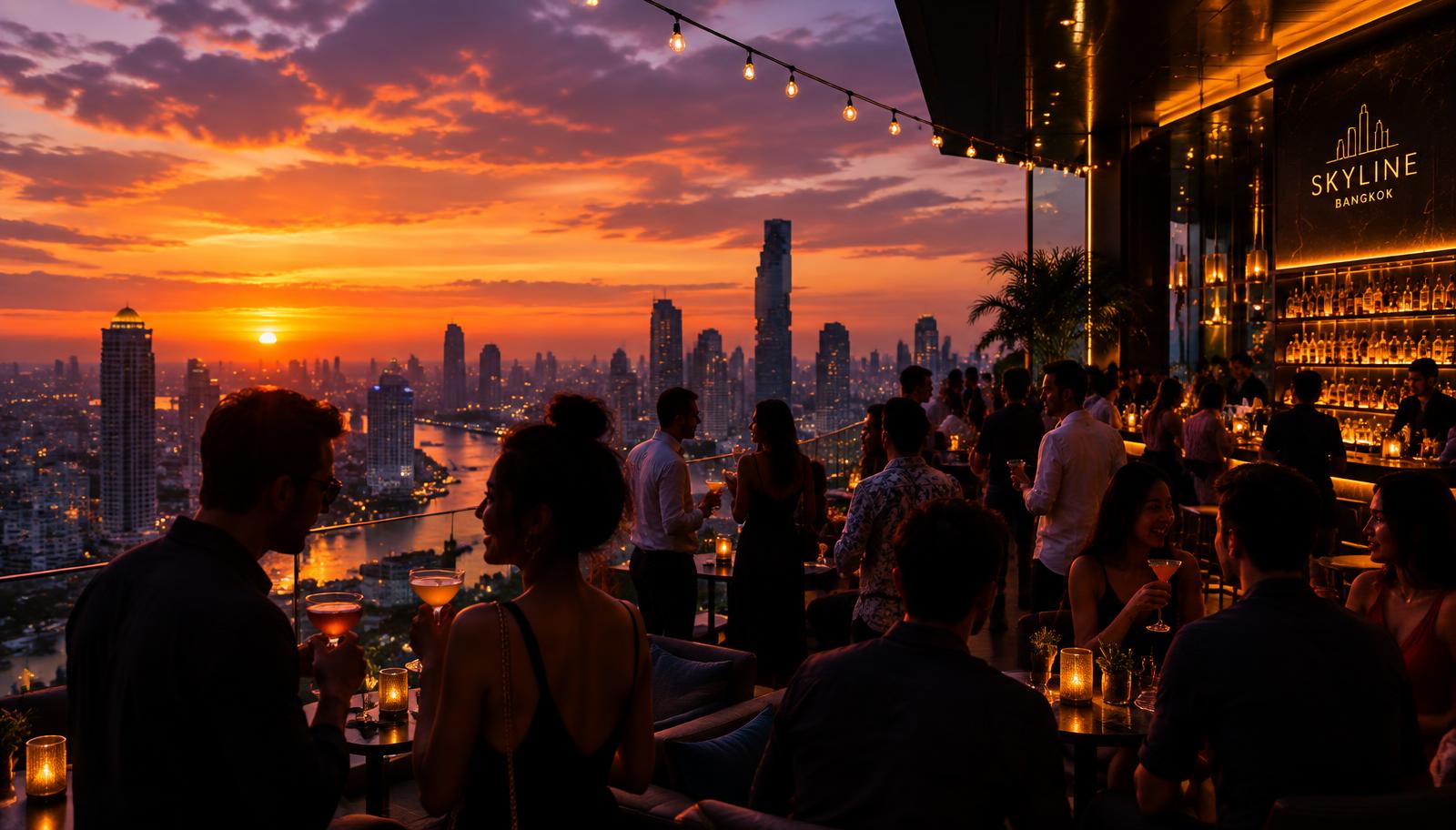
The clearest expression of the happy hour economy is the rooftop sunset window. The great rooftop views of Bangkok — the river bending through the city, the skyline stacked to the horizon — cost nothing to look at, but the bars built on top of them charge hotel-bar prices after dark. Between roughly five and eight, those same seats often drop by forty to fifty percent.
This creates one of the best value moments in world drinking: a table on a 50th-floor terrace at 6:15 p.m., a two-for-one signature cocktail in front of you, and the sun going down behind the towers for free. The rule of thumb is simple. If a rooftop's cocktails run 400 to 600 baht on the evening menu, check the daytime or sunset menu before you write the place off. The same drink, ordered before eight, regularly lands under 300. Go for the first drink at sunset prices, stay for the second round at full price, and you have still had the skyline for half of what the table next to you paid.
One caveat earned from experience: the sunset window is when everyone else has the same idea. The best-view tables fill by 5:30 on any evening with decent weather. Show up early or accept the bar seats — and honestly, the bar seats at a great rooftop, with the bartender working in front of you and the city below, are not a consolation prize.
Beer towers and street-corner math
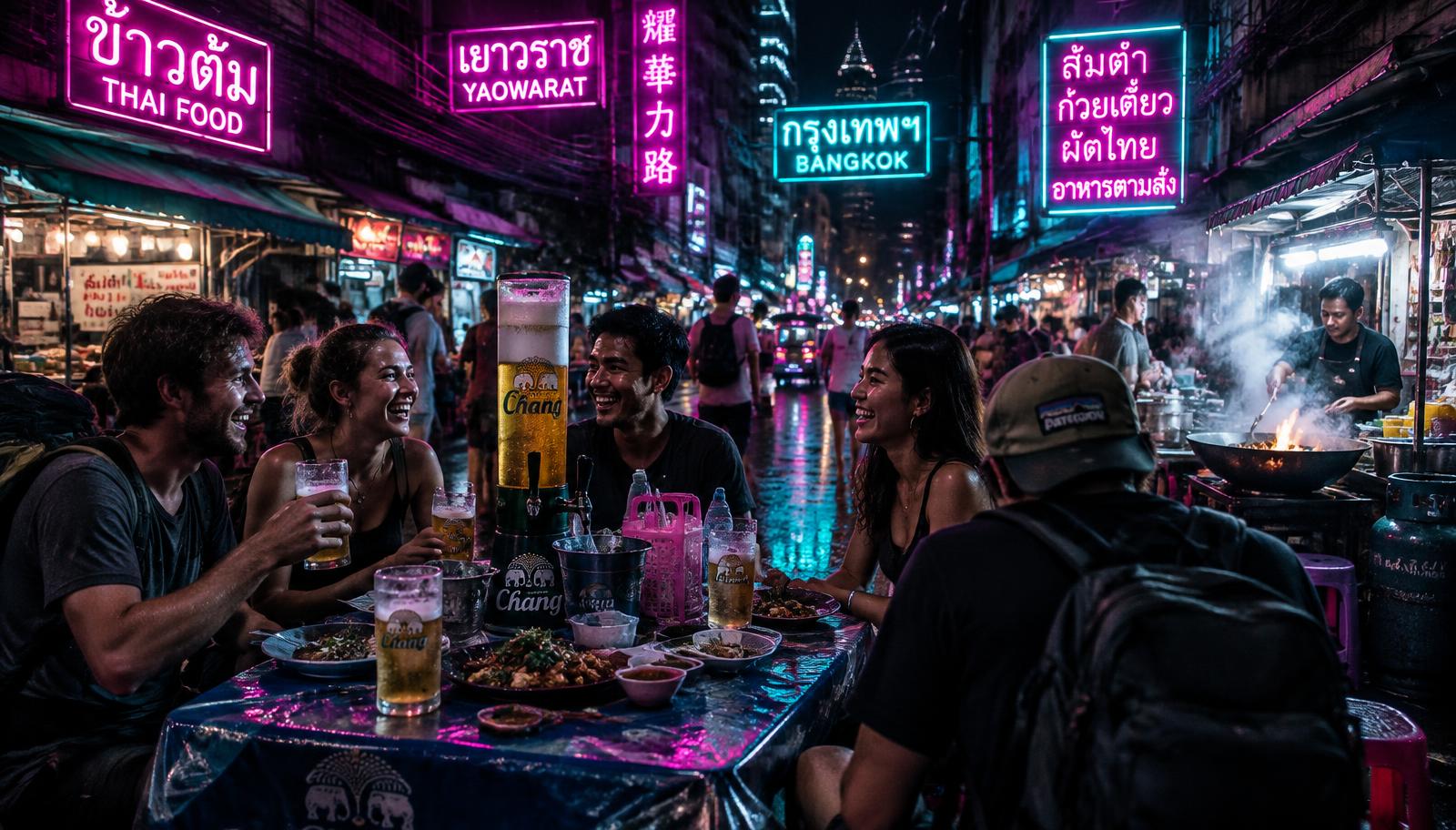
At the other end of the price spectrum, the street bars and open-air sois run their own happy hour economy, and it has its own unit of measurement: the beer tower. A liter of Thai beer on ice, served in a plastic dispenser with a tap at the bottom, sitting in the middle of the table between a plate of grilled pork and a plate of som tam. It is engineered for sharing, priced for volume, and it is the reason a night that starts at a street table on a soi like 11 can cost less than a single cocktail elsewhere in town.
The street version of the happy hour is less a discount and more a permanent price point, but the deals exist there too — bucket specials in the backpacker zones, happy hour pints in the expat pubs, and the unadvertised kindness of a bar owner who rounds down when you have been sitting there since sunset. The sports bars along Sukhumvit run some of the best value in the city: a long happy hour on draft, big screens, and food prices that let you eat dinner while you drink. If your measure of a night is hours of enjoyment per baht rather than complexity per sip, this is where Bangkok wins globally.
The craft tier plays too
What surprises people is that the fancy rooms — the speakeasies, the craft cocktail bars, the gin dens — have joined the discount economy as well. The pattern looks different here. Instead of two-for-one on everything, the craft bars discount selectively: a specific list of four or five signature drinks at a reduced price in the early hours, or a "first pour" deal that applies to your first round only. It protects the margin on the rare stuff while still giving the curious a cheap door into a room they might otherwise save for a birthday.
This tier also runs the daytime flip side: many of Bangkok's best cocktail bars are nearly empty between four and seven on weekdays, and some respond with afternoon deals that are frankly absurd — top-shelf drinks at street-pub prices, simply because the alternative is an empty bar. The quiet weekday afternoon session, drink in hand while the city hums below, is a local's secret that is entirely available to visitors.
Ladies' night and the calendar economy
The happy hour economy extends across the week. Most nights of the week, some bar somewhere in Bangkok is running a themed promotion: complimentary drinks for women on a designated ladies' night, industry nights on the evenings bar staff themselves go out, buy-one-get-one wine deals on the slow midweek stretch, and beer-promotion nights backed by the big Thai brewers, where their brand's bottles go out at a discount and the promoters hand out merchandise. None of this is hidden — it is printed on A-boards on the pavement and pinned to every bar's social feed. A visitor who spends ten minutes on a Monday looking at what the bars along their street are running that week can plan five nights of drinking at roughly half the walk-in price.
The one habit worth unlearning is the assumption that a promotion means a lesser bar. In Bangkok the discount is not a distress signal — it is the market working. The city has more good bars than it has prime-time hours, and the competition for the early evening is permanent. The bars use discounts the way airlines use off-peak fares: same seat, same service, different clock.
How to actually run a cheap week in Bangkok
Put it together and the strategy writes itself. Start each evening inside the sunset window: rooftop or riverside, two-for-one cocktails while the light dies. Move to a craft cocktail bar for the second round, using its early-evening signature list if it runs one. Finish wherever the night pulls you — a street table, a sports bar with the football on, a speakeasy that doesn't open until ten. Drunk that way, a full Bangkok night that touches three of the city's best rooms costs about what two full-price cocktails would have at a hotel bar.
The deeper point is that happy hours are not a budget travel hack bolted onto Bangkok's nightlife. They are the way the city's nightlife actually functions — the mechanism that fills the terraces at six, gets the speakeasies a curious crowd at seven, and keeps the street tables loud until the towers' lights have long gone out. Bangkok rewards the drinker who reads the clock. Show up at the right hour, and the most expensive-looking city in Southeast Asia quietly becomes one of the cheapest places on earth to drink beautifully.